How the Seller Disclosure Law of PA Affects Buyers and Sellers

Whether listing your home or purchasing a home in Pennsylvania, a Seller’s Disclosure is one of the most important documents in a real estate transaction. The Seller’s Disclosure is a form used by a seller to provide information about the condition of the property or known material defects in and around a property prior to a sale.  

Prior to 2000, buyers in Pennsylvania were in a position of caveat emptor, or buyer’s beware. It was the responsibility of the buyer to perform their due diligence about the condition of a potential property and uncover any of the wide number of issues that may impact the functionality and safety. The addition of the Seller Disclosure Law is one of many ways in which a consumer of real estate has gained more transparency about a potential purchase.

The Seller Disclosure Law applies to any interest in the transfer of real estate that contains between one and four residential dwellings. Though a buyer is purchasing a property “as is,” with terms that can be negotiated between parties, the seller has an obligation to inform a buyer on the property’s known condition. A seller must provide a seller’s disclosure form prior to a transaction and cannot provide false or misleading information about the property, including known material defects.

Some of the areas of a property subjected to the seller’s disclosure include the roof, attic, basement/crawl space, any additions or alterations, plumbing, HVAC, water and sewer, hazardous materials, windows, water intrusions, and the appliances or fixtures included in the Agreement of Sale, among others.

There are a few exceptions in which a seller does not need to complete a Seller’s Disclosure form.

If the property is being sold through administration, guardianship, conservatorship, or through a trust, the seller’s disclosure is not required, but the noted executor is required to disclose any known defects. If the property is a new construction transfer, the property does not require a seller’s disclosure if the builder issues a home warranty good for one year or longer and the property has been inspected and determined to be up to code according to the local township.

A commercial property that includes four or less dwellings (ex. storefront w/ upstairs units or a farm w/ additional units to rent) is responsible for a seller’s disclosure, however, a multi-unit property with more than four units does not require a seller’s disclosure because multi-unit properties are subjected to use and occupancy certificates prior to a transfer, which require an inspection and specific items in the dwelling to be up to code according to the local municipality.

Condo and coop owners are required to share a seller’s disclosure, but only for their specific unit and not the common areas.

Other exceptions include the transfer from one co-owner to another, a transfer to a spouse or direct descendent, the transfer of a property about to be demolished, or the transfer of a property that is court-ordered either through a foreclosure process or divorce settlement from one spouse to the other.

Even if the seller never lived in the property (i.e. a landlord), the seller still has in-depth knowledge of the property and must complete the SD. A power of attorney must complete the SD, however, they are only required to provide relevant information to the best of their ability.

Depending on the state of the probate process, a seller’s disclosure is not required if the property is being sold by the estate so the proceeds can be distributed to the beneficiaries. However, if the beneficiaries have inherited the property and taken title, they are required to provide a SD.

It’s also important to note that anything that is not material (i.e. previous injuries, deaths, ghosts, mental anguish) does not need to be disclosed.

If a seller is found to be aware of a problem they did not disclose, they may be responsible for any financial losses or repairs incurred by the buyer. Proving the seller withheld information or knowingly covered up defects is sometimes difficult to prove, so contacting a real estate attorney is the first step for a buyer if they uncover an issue that should have been disclosed. Litigation must be presented within two years of settlement.


For an example of how the law has been applied in Pennsylvania, read more here:

 https://www.zarwin.com/news-article/as-is-sales-of-residential-real-estate-and-the-duty-to-disclose-let-the-seller-beware/

For more information on the PA Seller Disclosure Law:

 https://www.pa.gov/content/dam/copapwp-pagov/en/dos/department-and-offices/bpoa/real-estate/Seller%20Disclosure%20Law.pdf

What To Expect In Real Estate Trends For 2026

Though it doesn’t feel like it, in a few short weeks we’ll be criticizing a groundhog, watching somebody else’s team play in the Super Bowl, and going all out on the slopes while the getting’s still good. The spring market is not too far behind. In many areas, including our own, it never really went away. Just reduced from a boil to a simmer.

Many experts predict 2026 to be a stronger year for home buyers, so the early months present an ideal time to develop a strategy with an experienced real estate professional.

At the end of 2025, our area saw signs of balancing, and 2026 could provide the plateau that gets many buyers, especially, first time home buyers, into their new home.

“Home price growth will be minimal,” said Lawrence Yun, chief economist for the National Association of Realtors, “roughly 2% to 3%, about the same as overall consumer price inflation.” Yun also anticipates a growth in wages. “It’s a year where people’s income begins to rise a little faster than consumer inflation and home prices—and this is a welcoming development. We want people to have more purchasing power. Home prices are in no danger of any major decline, and even a 3% gain will bring smiles to many homeowners.”

Many of the challenges in recent years for buyers has come from a limited supply. “Even though inventory has increased in most markets, there’s still a structural housing deficit,” said Robert Dietz, chief economist for the National Association of Homebuilders. “The housing stock is not large enough given the size of the population. This housing deficit remains a constraint on affordability. The only way to really solve the housing affordability challenge is to build our way out of it.”

Danielle Hale, chief economist for Redfin, points out the rise in price sensitivity to indicate a balancing market. “In recent data, we’ve noticed that the share of sellers pulling their homes off the market is higher than normal,” she said. “Even then, it’s still only about 6% of listings, so it’s not the norm. What it reflects is a more balanced housing market where not every seller is getting exactly what they want. Some are choosing to come down in price, and others are choosing to walk away and come back at a later date because they have the flexibility.” Hale also suggests that with a combination of price reductions and lower interest rates, the average monthly payment is now believed to decline for the first time since 2020.

With mortgage rates expected in the low-6% range for 2026, the combination of price adjustments and more inventory could be enough to get many first-time homebuyers in on the action. However, Hale also says that middle-income buyers are also feeling the pinch as the percentage of homes they can afford has dropped from 50% to 21% from pre-pandemic levels to now.

At the national level, the Northeast is still in better shape than other parts of the country. According to research from Price Waterhouse, the Northeast ranks second in the country for year-over-year new single family home net sales per community with an average 1% increase, trailing only the Midwest (7%). However, Southern California (-39%), Florida (-29%), and the Southeast (-22%) have seen the largest declines.

What does this mean at the local level?

In Bucks County, home sale prices took a dip in November but returned to average levels with a median price of $510,000 and total of 571 sales in the month, the highest monthly total over the past six months. Homes spent an average of 34 days on the market in December, well above the six-month average of 24. The year-to-year average home sale price rose by 10.8%

Montgomery County saw a steady average of home sale prices, following a second-straight month with a median of $455,000, still slightly below the six-month median of $460,000. Homes spent an average of 30 days on the market in December, up from the six-month average of 24. With 751 total sales in the month, the county also saw a bounce back in overall sales, but not as high as in the late summer months. The year-to-year average home sale price increased by 1.1%.


The Ins and Outs of Mortgage Contingencies

Unless they have hundreds of thousands of dollars lying around, most potential homebuyers will be acquiring a mortgage to purchase a home. In order to obtain a mortgage, a prospective lender will comb through the buyer’s finances and decide whether or not they are financially capable of affording the home. This process can be both stressful and time sensitive for all parties involved, which is why most real estate professionals recommend an early pre-approval to alleviate some of the tension and confusion of the homebuying process.

Because most buyers require financing, a majority will add a mortgage contingency to an offer on a subsequent home purchase. A mortgage contingency is a clause in an Agreement of Sale that protects the buyer (and seller) from following through with an agreement the buyer cannot afford. In most situations, a mortgage contingency allows a buyer to walk away from a transaction without suffering any legal repercussions or financial liabilities.

In Pennsylvania, there are several ways a mortgage contingency can affect the success of a transaction.

With the help of a lender prior to writing an offer, a buyer will submit a range of potential interest rates on the Agreement of Sale during the pre-qualification stage. After the application process, if the expected interest rate exceeds the maximum amount designated within the 30-60 days between offer acceptance and execution due to extreme fluctuations, the buyer can terminate the contract. This protects a buyer in cases of economic instability outside of their control, which is not as common unless the country’s economy experiences high volatility like we’ve seen in recent months.

Outside of economic volatility, mortgage contingencies have more likely conditions, which is why it’s one of the most important parts of a real estate transaction. When submitting an offer, the buyer will agree on a mortgage commitment date, a date prior to settlement in which they expect to obtain a mortgage approval. Typically, this falls within two weeks prior to settlement on a 30 day closing or a little earlier for a 45-60 day closing.

The buyer must continue to demonstrate good faith in receiving mortgage approval, even if they may not be approved. If a buyer’s mortgage application is denied by a lender, and the buyer either provided inaccurate information or did not do their due diligence, the seller may terminate a contract, and the buyer may lose their deposit.

However, if the buyer does everything within their control to pursue a loan and is denied, they are entitled to a return of their deposit. Any costs the buyer incurs as part of the mortgage approval process (appraisal, title insurance etc.) will be taken as a loss.

How does a mortgage contingency affect the seller?

As stated above, the seller has some control to terminate a deal if the buyer does not hold up their end of the commitment. A seller can terminate a contract if the buyer does not present a mortgage approval by the stated date, the approval does not satisfy the loans terms as stated in the contract, or if the buyer’s mortgage approval has additional conditions not specified in the Agreement of Sale that are not removed with 7 days after the commitment date (conditional home sale, inaccurate approval date, etc.).

A mortgage contingency also affects a seller when the seller receives multiple offers and must evaluate the strength of each offer. The contingency is another way out for a buyer, which means if the buyer doesn’t gain mortgage approval, a seller may be forced to put the house back onto the market, which can be costly, especially if the seller is under contract for a new home of their own.

Another option for a seller, though not as common, can be to offer financial support for a buyer so the mortgage can be approved. Similar to a seller’s concession in another section of the Agreement of Sale, sellers have the ability to pay for loan origination fees or points to help a buyer get their rate within the range stated in the contract. This can be a loss for the seller but means the deal can proceed without the issue of the contingency. If the seller were already planning to contribute to a buyer’s closing costs or agent compensation, this could move support from one place to another to secure the deal.

The final hurdle of the mortgage contingency involves needed repairs before a lender or insurance company can approve the mortgage. These issues would be found during the appraisal and not necessarily the home inspection. Though substantial issues would likely appear in both, the home inspection is a separate contingency with its own conditions. If a property requires immediate repairs in order for the buyer to obtain mortgage approval, a buyer must notify the seller of the repairs, and a negotiation period will follow. Both the buyer and seller will have their own exits if either party does not respond or cooperate with the necessary demands.

What if a buyer chooses to waive a mortgage contingency?

Many believe this makes the offer a cash offer, yet this is misleading. A buyer may waive a mortgage contingency regardless if they are using cash or require a mortgage. Waiving the contingency only means the deal is not dependent on acquiring the mortgage. A buyer who waives the mortgage contingency and who still plans on using a mortgage for funds likely has solid financial footing and confidence they’ll be approved. Waiving a mortgage contingency strengthens an offer, removing a potential buyer exit. If a buyer waives the mortgage contingency and does not qualify for a mortgage, the next steps become complicated because they could owe the seller a substantial amount of money or find another way out.

In most transactions, a seller will request a Buyer Financial Information sheet, which will highlight a buyer’s assets and liabilities to determine buying power. Sellers view this statement if the buyer is presenting an all-cash offer but will also analyze this document if the buyer is obtaining a mortgage for the reason stated above. A seller must do their due diligence as well and be certain a buyer can perform their end of the deal before acceptance.

Although mortgage contingencies have strict conditions, a majority of real estate transactions are dependent on a loan approval process. An experienced, trusted real estate team, which includes agent, lender, title company, and insurance provider can help potential homebuyers get through the variables and into their new home with ease.

5 Answers For Potential Homebuyers Entering the Spring Market

Potential homebuyers are flooded with misinformation: there’s no inventory, interest rates are too high, or saving for a down payment has become too hard. The list of reasons not to buy continues, but the truth is the real estate market is alive and kicking, and it’s about to pick up. The spring market is one of the most active periods of the year. It’s a time of stability between the holidays (extended this year with a Super Bowl parade) and the end of the school year where summer camps and family vacations alter routines. With February breezing by, and Punxsutawney Phil’s prediction of 6 more weeks of winter halfway over, potential homebuyers should be preparing for the next steps before we’re celebrating the 4th of July with fireworks and the Club World Cup at Lincoln Financial Field, wondering where the last six months have gone.

Here are five answers potential homebuyers should know before entering the spring market.

Know Your Why

Whether it’s to find stability, build equity, get away from annoying neighbors, or because life changes happen, a quest for a home starts with a clear objective for exploring what often times can be referred to as the most stressful life decision. Too often this foundational question gets confused with Is it the right time to buy? It’s always the right time to buy. The market doesn’t wait for anyone, but it’s also not a race to the closing table. It should be the right time to buy for the individual(s), and the reason should drive everything else.

Know Your Financial Limits

It’s fun to search online for the dream house with modern updates, an acre yard, two-car garage (Porsche included), fully finished basement, and swimming pool with a patio kitchen. It’s human nature to want something attractive that stretches our boundaries. I want midfield seats every 2026 FIFA World Cup game in Philadelphia. Maybe dabble in a few other cities, too. Why not? These same desires can lead us astray when buying a home, so a potential homebuyer’s next step relates to affordability. An experienced real estate agent can help foster a relationship with a lender, who becomes an integral part of the home-buying team. If securing a mortgage, a future owner needs to project future monthly payments, which includes taxes, insurance, maybe PMI or HOA dues. A mortgage is influenced by debt-ratio and debt-to-income ratio, two key numbers that affect buying power and staying power, along with credit history and employment stability. Once a lender analyzes those numbers and an affordability range becomes more specific, a potential homebuyer will factor in utilities and other monthly payments (car, credit cards, loans, etc.). Only then is it time to explore houses.

Know Your Search Area

Expert knowledge of the search market is one of the biggest skillsets a real estate agent can provide a potential homebuyer. While many of us may drive the same routes to school, the food store, hardware store, our favorite restaurants, or soccer practice, we are so consumed with life and our 90s hip-hop playlists to notice the transactions happening all around us. Real estate is hyper-specific. The value of the same property in two different neighborhoods can vary for a number of reasons. Curb appeal, homeowner maintenance, location, and local economy trends are only some of the factors that influence value. Just because one property sold for X amount last spring doesn’t mean it will hold the same value this spring. It could be higher or lower. A property may sell in five days while a similar property in another area sits for months. Value is not an exact science, but knowledge of the search area and comparable details (bedrooms, bathrooms, basement, garage, yard, pool etc.) puts any potential homebuyer in a better position to find the right home before it’s gone.

 Know Your Competition

Although a positive mindset helps turn those dreams into reality, potential homebuyers aren’t alone. Many other qualified buyers are looking for a similar home with many of the same features in the same area, and they may be presenting more attractive offers. Each situation is different, but before visualizing the tap-in closing and house-warming party, future owners must prepare for competition and decide with an agent how they will stand out. Sometimes, the best offer isn’t always the most lucrative. Sellers have their own WHY. Do they need an early closing? A later closing? Are they financially stressed? Do they want the most secure financing? Do they want to sell “as is?” Do they have their own emotional attachments? Are they already living somewhere else? These are only some of the many questions that could alter the direction of what would make the best offer to match the sellers’ WHY.

 Know the Process

In a perfect world, the potential homebuyer finds the dream home on day 1, submits a great offer (under ask) that gets accepted, and moves right in 30 days later with no hang-ups or required maintenance. Search To Turn Key, or STTK. It doesn’t always happen that way, but if it does, they are organizing the next outing to the sports book. In most scenarios, the home-buying process takes time. And why rush? As stated earlier, there’s no race to the finish, but there may be situations that affect the smoothness of the ride. The right house may not be available. Offers have counter-offers or rejections. Buyers have contingencies. Inspections uncover major flaws. Financial lightning bolts disrupt mortgage approval. Homes may appraise for less than the agreed contract price. Settlement dates change. These are only some of the situations that affect the process. Despite challenges, an experienced agent can help stabilize the home search until it’s time to for the homebuyer to walk up the front steps and into their new home.  


Residential Housing Trends in 2025

As a new administration transitions into the White House and the Fed continues to play with interest rate cuts, many home owners and potential home buyers are left wondering what impact it will have on the housing market. Very little, according to some experts. Freddie Mac reports the current 30-year fixed interest rate range remains between 6.08%-7.44% over the past 52 weeks. Potential buyers and home owners looking to refinance should expect the lower end in 2025 but no significant drop.

2024 saw a record-high for cash buyers, who made up 26% of the market. The year also saw a record-high for median age of first-time home buyers, rising to 38 years old. As buyers navigate inflation, interest rates, and cash flow availability, many are tapping into alternate sources to complete home sales. 25% of buyers used a gift or loan from a friend to purchase, 20% took out money from financial assets, and 7% used inheritance money.

Multi-generational households rose to 17%, an all-time high, which means that many families are pooling resources to make homeownership more affordable. Single women made up 24% of the market compared to 11% of single men.

The Bucks County Association of Realtors reports the median sales price throughout the county is $500,000, up 6.4% from October and a 13.4% increase from November 2023. Homes have sat for an average of 25 days, up one more day than the 5-year average. The association also reports less competition for homes this year than last year, which is a positive sign for buyers. Contract ratio, which measures how many buyers are competing for the same home, was 1.04 buyers per home in November, up from October’s 1.03 but down from November 2023’s 1.16 and significantly down from the 5-year average of 1.44 buyers per home.

At the national level, Lawrence Yun, Chief Economist for the National Association of Realtors, reports that home sales should rise in the coming years. The 3% year-over-year gains in 2023 and 2024 are a sign that the housing market should improve. He predicts existing homes sales to rise by 9% in 2025 with new homes sales up 11%. In 2026, he sees existing home sales to rise 13% in 2026 with new homes sales tapering to 8%.

Source: Bright MLS


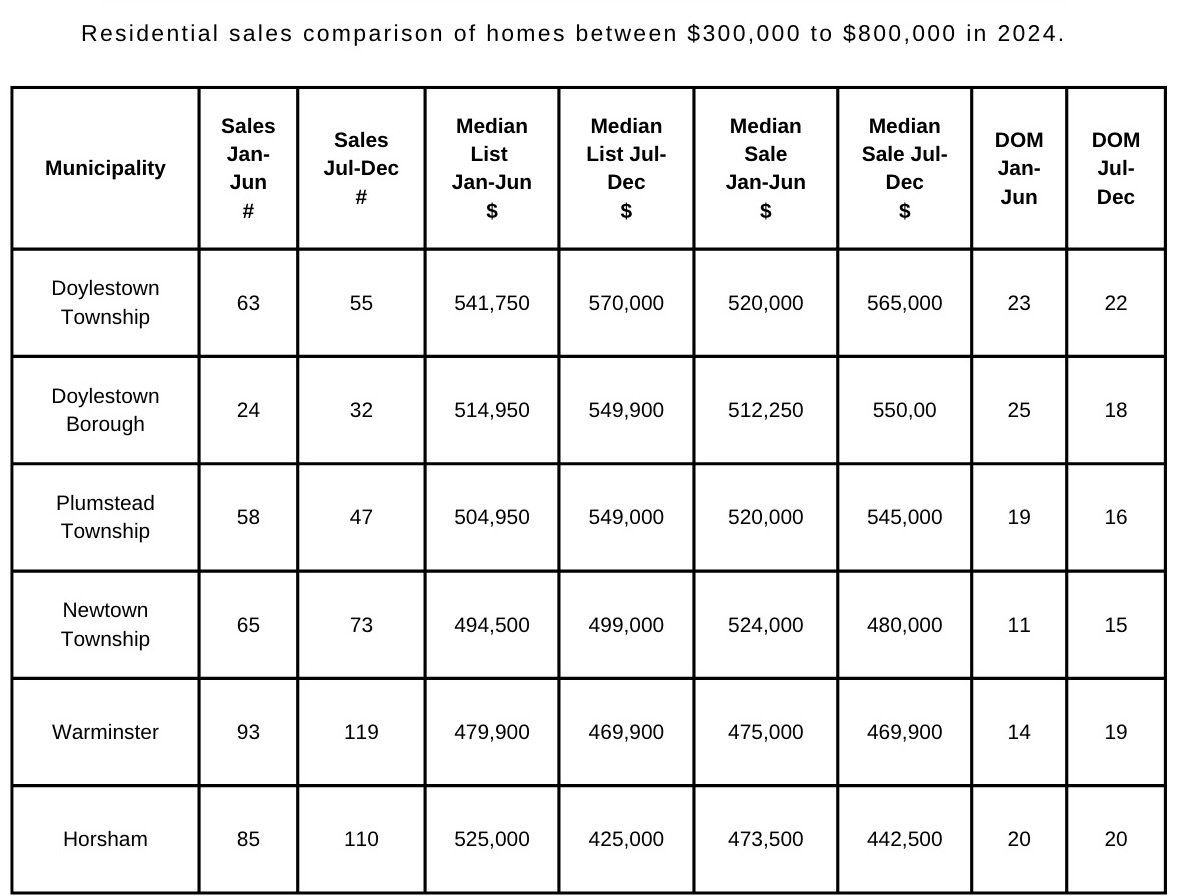
From this time last year, half of the highlighted markets exceeded 2023 sales while the other half fell slightly below the previous year, but the average percentage shows a 6% increase from 2023 totals. In all of the markets, except Doylestown Township, homes have been listed at higher prices than in 2023 with an average increase of 8.1%. Homes in Newtown Township and Plumstead Township have listed for significantly higher than in 2023. In all but Doylestown Borough, sales prices have gone up. Plumstead Township and Horsham Township have seen significant rises in sale prices, 16% and 10% respectively.

Homes in the highlighted markets are generally spending more time between listing and closing. Houses in Doylestown Township have seen the biggest change in time on the market, reaching an average of 36 days in 2024. Homes in Plumstead Township, to go along with rising sale prices, have spent fewer days on the market, a 21% difference, which means this is one area that still remains a seller stronghold. Doylestown Borough has also seen a slightly less than 30% decrease in days on the market but sales prices have also decreased by of over 2%. As a whole, the highlighted markets average a 7.8% increase in sale prices from 2023 to 2024 while spending just over 5% longer on the market, which is consistent with both local and national trends.

Source: Bright MLS


Breaking down the first half of 2024 versus the second half of 2024, home sale prices in the $300,000 to $800,000 range went down in Newtown and Horsham, which saw decreases of 8.3% and 6.5% respectively. Plumstead saw a 4.8% increase, Doylestown Township an 8.6% increase, Doylestown Borough a 7.3% increase, and Warminster dipped 1%, for a .8% average increase among the six markets. Houses in three of the markets (DT, DB, and PT) sat fewer days in the second half of the year while Newtown and Warminster followed the local and national trends. Newtown’s and Warminster’s numbers show a balancing market toward the end of 2024 with decreases in sales prices and more time spent between listing and closing.

Buyers Post-NAR Settlement

If you haven’t been following the real estate market lately, you may have missed the latest news to affect the homebuying process. Earlier this year, the National Association of Realtors settled a class action lawsuit over alleged antitrust violations, which resulted in slight changes to how real estate transactions occur moving forward. Though the NAR affirms that agent commissions have always been negotiable, the center of the issue is the communication and transparency of consumer information. As a result, the consumer is now more informed when entering a transaction, and though current homebuyers may have been affected the most, the long-term benefit of the settlement lies within the homebuyer’s control in the process.

So what’s changed?

Agreements between a buyer and broker via an agent are now required before an agent is permitted to show a home.

Though buyer agreements have been strongly recommended for decades, most real estate buyer-agent relationships had been solidified through an Agreement of Sale. Buyer agent compensation is Included in this agreement. Prior to August 17th 2024, buyer agents were typically paid by the seller through what is known as a broker cooperation agreement. Essentially, a seller’s agent was paid a commission by the seller then split that commission with a buyer agent for bringing the buyer to the table. The buyer didn’t need to put up the funds necessary to pay their agent because compensation came from the seller. That has since changed. A buyer is now responsible for compensating their agent as agreed to in the buyer agency contract, and that number has to be specific in the BAC, whether a percentage of the sale price, a flat amount, or any other agreed upon number.

What’s important to note is that agent commissions are negotiable. When buyers are about to work with an agent, they should have conversations upfront about what the agent will do and what their time and efforts are worth. Also, buyers do not need a contract to speak with an agent at an open house or inquire about their services.

During this post-settlement transitional period, buyers may be better informed about their options but may not be financially prepared to incur these extra costs. Fortunately, support may still come from the seller. In an Agreement of Sale, two categories under Seller Concessions define how buyers may request financial support. Sellers may offer a buyer broker fee or closing cost assistance. The buyer broker fee refers to a buyer asking a seller to cover some or all of their agent’s commission. Sellers may still approve a seller’s agent to share a portion of the commission with the buyer agent as had been done in the past. All that transaction requires is an additional form that recognizes the agreement between two cooperating brokers. This section asks a seller directly for support. Closing cost assistance, formerly known as a seller’s assist, provides money back to a buyer at closing to pay for costs not associated with buyer broker fees. So whether it’s support with an agent commission or additional closing costs, a buyer may receive assistance from the seller to secure the deal. Other options for buyers to find additional funds should be discussed with a mortgage lender.

But why would a seller offer assistance to a buyer’s agent? For the simple reason that sellers still need buyers. Even in a seller’s market, more buyers means stronger offers. Sellers who fail to offer some sort of cooperation this soon after the settlement changes could be losing out on an opportunity to reach motivated buyers.

The second change to come out of the settlement for buyers focuses on the role Multiple Listing Services play in the sharing of information. MLSs are the most prominent way brokers share information with other brokers. After August 17th, 2024, seller agents are not permitted to advertise buyer agent compensation through the MLS. Sellers can still offer buyer agent compensation, as stated earlier, but must relay that information through other forms of communication (conversations, company website, flyers, signs, social media, etc.). A buyer’s agent can’t just rely on the information through MLS. They will need to pick up the phone or check another source.

In the end, the recent changes from the NAR settlement should bring more awareness to the buyer about the process of real estate transactions and encourage transparent conversations about a buyer-agent relationship. That in itself, should help buyers navigate one of the most stressful financial decisions of their life.

If you’d like to subscribe to Forward Thinking, a newsletter that combines real estate, soccer, performance, and more, click on the link below.

www.gregoldfield.com/forwardthinkingsignup